How to Build Generational Wealth for Your Family: A 10 Year Indian Roadmap
The Morning That Changed Everything
Vikram Mehta was 54 years old when he sat across from his chartered accountant in a quiet office in Andheri and heard something that stayed with him for years. He had spent three decades building a distribution business. His father before him had sold cloth in Chandni Chowk. Vikram had upgraded the family from a single room in Karol Bagh to a three-bedroom flat, two cars, and a respectable bank balance. By almost any measure, he had done well.
His CA placed a simple sheet of paper on the table. It showed the rough trajectory of Vikram's estate over the next twenty years if nothing changed. Divided between two children, taxed at the margins, sitting in fixed deposits earning six percent while inflation quietly ate into it, the number that represented Vikram's life's work would shrink to something unrecognisable within a single generation.
“You have built wealth,” the CA said, “but you have not yet built a system that preserves it.”
That distinction, between earning wealth and building a system that outlives you, is the subject of everything that follows.
This is not a guide for billionaires. It is a guide for every Indian family that has worked hard, saved carefully, and quietly wonders whether what they have built will still be standing when their grandchildren need it.
“The goal is not simply to leave money behind. The goal is to leave a structure that keeps producing money long after you are gone.”
India Is at a Generational Wealth Crossroads
India is experiencing the largest intergenerational wealth transfer in its history. The generation that built businesses from scratch in the 1980s and 1990s is now in its fifties and sixties. Their children, educated, ambitious, and often living in different cities, are inheriting wealth they never had to build themselves. That combination, sudden inheritance without the frameworks to manage it, is where most family fortunes quietly disappear.
Research on family wealth globally shows a consistent and sobering pattern. Seventy percent of wealthy families see their wealth fully dissipated by the second generation. By the third generation, ninety percent of it is gone. India is not immune to this pattern. In fact, the absence of formal estate planning structures, the underdeveloped culture of long term investing, and the complexity of Indian tax law make the problem worse here than in most developed economies.
But the other side of that story is just as true. The families that do preserve and grow wealth across generations are not uniquely lucky. They are uniquely structured. They made a set of specific, deliberate choices early enough to matter. The ten year roadmap in this article is built on exactly those choices.
| Reality | Statistic |
|---|---|
| Family wealth gone by second generation | 70% |
| Family wealth gone by third generation | 90% |
| Indian household savings held in fixed deposits and gold | Over 60% |
| Indians with a written will or estate plan | Less than 10% |
What Generational Wealth Actually Means
The phrase “generational wealth” gets used loosely. Before building a plan around it, it is worth being precise about what it means in the Indian context.
Generational wealth is not simply the money you leave behind when you die. Generational wealth is a set of productive assets, financial habits, legal structures, and institutional relationships that keep producing value for your family members who come after you, regardless of whether those family members are financially sophisticated themselves.
In practice, this means four things working together. First, income producing assets that do not require you to show up every day. Second, legal structures like wills, trusts, and holding companies that protect those assets from fragmentation, litigation, and tax erosion. Third, financial literacy and habits passed down to your children so they do not undo in five years what took you thirty to build. And fourth, the right advisors and institutions in your corner who keep the system running efficiently.
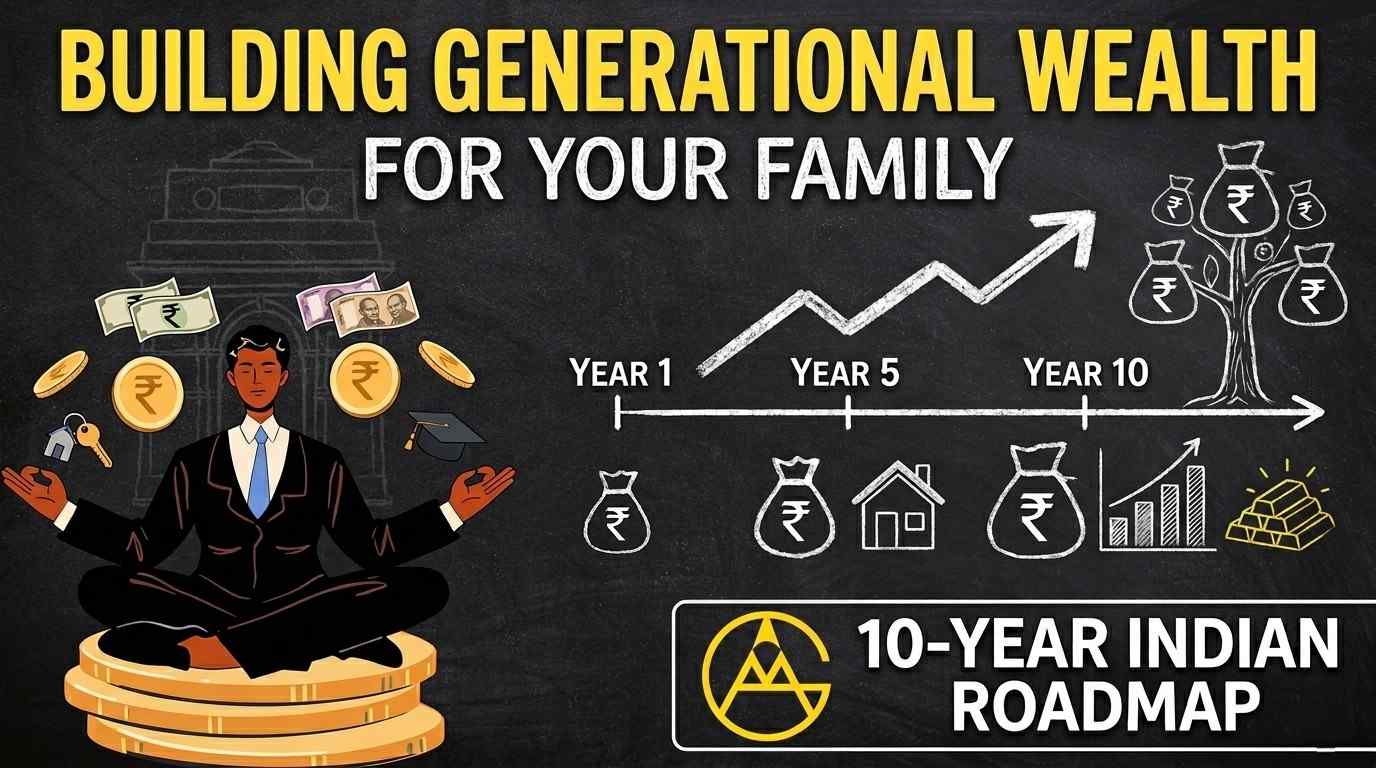
The ten year roadmap is structured to build all four of these in sequence. You cannot build them all at once. You build them in the right order.
“Generational wealth is not a number. It is a system. Systems outlive their builders. Numbers rarely do.”
Phase One (Year 1 and 2): Build the Foundation
Renu Kapoor is a 38 year old doctor in Pune. She and her husband Suresh, an engineer, bring home a combined income of approximately forty lakh rupees a year. They have savings, some mutual fund SIPs, a flat they purchased on loan five years ago, and a general sense that they are doing all right. When a financial planner sat down with them, however, the first thing that became clear was that they had no plan. They had habits, but habits are not the same as a plan.
The first two years of any generational wealth journey are not about investing aggressively. They are about getting the foundation right so that every rupee you invest after this point is working as efficiently as possible and protected from unnecessary erosion.
Step 1: The Complete Financial Audit
Start with an honest inventory of everything you own and everything you owe. Assets: savings accounts, fixed deposits, provident fund balance, gold, mutual funds, real estate, business equity, any listed stocks. Liabilities: home loan outstanding, personal loans, car loans, any informal borrowings from family.
Most Indian families have never done this on a single sheet. When Renu and Suresh did it, they discovered they had seven different bank accounts, twelve different mutual fund folios, and a gold holding spread across three bank lockers in two cities, none of which was documented anywhere. The audit itself, which took one afternoon, immediately clarified where their money was and where it was leaking.
Step 2: Get Your Tax Structure Right Before Everything Else
Tax is the single largest wealth destroyer for Indian families that ignore it. A family earning sixty lakh rupees a year can legally retain between eight and twelve lakh more every year simply by structuring their income and investments correctly. Over ten years, that difference compounds into a number that looks like a second property.
The areas to address in Phase One include optimising the salary structure to maximise allowances and exempt income, making full use of Section 80C, 80D, and HRA deductions, reviewing how investment income is being reported and taxed, and understanding whether a Hindu Undivided Family structure could provide tax benefits for your specific situation.
This is not about tax evasion. This is about not paying more than the law requires, which millions of Indian families routinely do simply because nobody ever sat down and structured things properly.
Step 3: Build the Emergency and Liquidity Buffer
Generational wealth building requires you to take calculated risks with a portion of your capital. You can only afford to do that when the rest of your life is protected from emergency disruptions. The rule of thumb is six months of household expenses in a liquid instrument. This is not an investment. It is insurance against being forced to break a long term investment at the wrong time.
Step 4: Protection First, Investment Second
The most overlooked part of wealth building in India is protection. Every wealth plan needs adequate term life insurance. The number should be at least fifteen to twenty times your annual income, not the three to five crore policies most middle class families hold. Alongside this, a family health insurance policy of at least one crore is no longer excessive in an era where a single ICU stay can cost twenty lakh rupees.
Renu and Suresh found they were underinsured by a factor of three. They had an endowment policy that was eating two lakh rupees a year in premiums while offering minimal coverage. Surrendering that policy and replacing it with a pure term plan saved them money immediately and gave their family eight times more protection.
Step 5: Write Your Will Before Year One Ends
This step makes most people uncomfortable, which is exactly why fewer than ten percent of Indians who need a will actually have one. The discomfort is understandable but the cost of not having one is enormous.
Without a registered will, your assets are distributed under the Indian Succession Act or personal law, which may not reflect your wishes at all. Family disputes over inherited property are one of the biggest destroyers of generational wealth in India. A valid, registered will written with legal guidance takes less than a day and costs far less than one month of family legal fees later.
Phase One Goal
By the end of Year 2, you should have a clear financial picture, an optimised tax structure, adequate protection, a will in place, and six months of liquidity sitting safely. This foundation makes everything in Phase Two possible.
Phase Two (Year 3 to 5): Grow the Engine
Arjun Nair grew up watching his father manage a small textile trading business in Coimbatore. By the time Arjun was thirty-two, he had a software job in Bengaluru, a good salary, and a growing conviction that a salary alone, no matter how large, would not build the wealth he wanted for his family. He was right.
Salaried income is the starting point. It is not the destination. The families that build true generational wealth in India are almost always families with at least one income producing asset or business that operates independently of the family members' time. Phase Two is about building or buying that engine.
Step 6: Build or Buy a Business
This is the step most wealth guides skip or treat as optional. It is not optional. The wealthiest families in India, at every level from regional traders to national conglomerates, have a business at the centre of their wealth. A business generates returns that financial markets cannot match when it is built and managed well. It also creates employment, builds brand equity, and produces cash flows that can be channelled into other investments.
For families that already have a business, Phase Two is about formalising it. Incorporating it as a Private Limited Company, getting the accounting and compliance right, and beginning to separate the family's personal finances from the business finances. This separation is one of the most powerful things a family can do for long term wealth, because it protects personal assets from business liabilities and enables far better tax planning.
For families that are salary based, this is the phase to explore entrepreneurship carefully. Not recklessly, but deliberately. A side business in a domain where you already have expertise, validated with small capital before scaling, can change the trajectory of a family's wealth within five years.
Step 7: Enter Real Estate With Purpose
Real estate is India's most trusted asset class and for good reason. Property in the right location delivers capital appreciation, rental income, and a tax efficiency that few other assets can match. It is also one of the most misunderstood investment categories in India, where emotional decisions and lack of research frequently result in capital being locked in low return properties for decades.
The distinction that matters is this: a home you live in is not an investment. It is a lifestyle asset. A property that generates rental income or appreciates in a commercially active corridor is an investment. Both have their place in a family portfolio, but they need to be understood and evaluated differently.
In Phase Two, the goal is to make the first deliberate real estate investment, distinct from your primary residence, in a location and asset type that serves your financial goals rather than your emotional preferences.
Step 8: Build a Diversified Investment Portfolio
A disciplined Systematic Investment Plan in diversified equity mutual funds, started early enough and sustained long enough, creates wealth that surprises most Indian families who have traditionally relied on fixed deposits and gold. The mathematical reality of compounding means that an SIP of thirty thousand rupees a month started at age thirty-five and sustained for twenty years at twelve percent average returns creates a corpus of over three crore rupees.
Phase Two is about structuring this portfolio intentionally. Not just starting SIPs, but thinking about asset allocation between equity, debt, and gold. About how much should be in domestic funds versus international funds. About how to use the Public Provident Fund and the National Pension System as long term tax efficient vehicles. About whether Sovereign Gold Bonds are a better way to hold gold than physical jewellery that is insured poorly and valued emotionally.
Arjun Nair, once he sat with a proper wealth advisor, realised he had been investing correctly but randomly, without any allocation logic. Consolidating and restructuring his investments, without changing the monthly amount he was investing, improved his projected twenty year outcome by over forty percent.
Step 9: Teach Your Children About Money
The most underestimated step in the entire roadmap. Generational wealth requires a next generation that understands and respects what they are inheriting. India's education system does not teach personal finance. Most parents do not talk about money with their children. The result is young adults who inherit significant assets and have no framework for what to do with them.
Starting in Phase Two, which often corresponds to when children are in their early teenage years, families should begin having transparent money conversations. Not lectures, but conversations. Let children see the family balance sheet. Let them participate in small investment decisions. Let them understand the difference between an asset and a liability before they are twenty years old.
Phase Two Goal
By the end of Year 5, you should have at least one income producing business or asset, a growing investment portfolio with clear allocation logic, a real estate position held as an investment, and children who understand the basics of financial decision making.
Phase Three (Year 6 to 10): Protect and Multiply
Sunita and Prakash Sinha built a successful chain of diagnostic centres across three cities in Rajasthan over twenty years. By their late fifties, they had real estate, a business, a substantial equity portfolio, and gold. They had, by any standard, succeeded. What they had not done was set up any structure to ensure that the wealth they had built would survive the transition to their three adult children, who had different temperaments, different financial habits, and different ideas about what the family should do with its assets.
Phase Three is the phase where wealth stops just being a number on a balance sheet and becomes a system. It is where the legal, financial, and human structures go into place. For most Indian families, this phase requires the most sophisticated guidance, but it is also the phase that determines whether everything built in Phases One and Two actually reaches the next generation intact.
Step 10: Estate Planning Beyond the Will
A will is the starting point of estate planning, not the end of it. For families with significant assets, a Private Family Trust is often the most powerful structure available under Indian law. A trust allows you to hold assets in a structured manner, define precisely how they will be managed and distributed, protect them from creditors and legal disputes, and continue operating even after the founder's death without the friction of probate.
The Sunita and Prakash Sinha scenario is precisely what a family trust is designed to handle. Rather than dividing the diagnostic centre business into three equal parts, which would have paralysed its operations and likely destroyed its value, a trust structure allowed the business to continue as one entity while distributing its income in proportions they defined themselves.
Family trusts in India are governed by the Indian Trusts Act and are a legitimate, widely used structure among high net worth families. Setting one up requires the right legal expertise, but the long term protection it provides is worth many times its setup cost.
Step 11: Business Succession Planning
In India, the transition of a family business from the founding generation to the next is one of the most financially dangerous events a family can face. Without a succession plan, decisions about who runs the business, who owns shares, and what happens in a dispute are left to chance or conflict. Most businesses that fail at the second generation do so not because of market forces, but because of internal family disagreements over control and ownership.
A succession plan has several components. First, a shareholder agreement that defines ownership stakes and what happens when a family member wants to exit. Second, a governance structure, often a family constitution, that defines how decisions are made when the founder is no longer running day to day operations. Third, a leadership development plan that identifies and trains the next generation of operators, whether that is a family member or a professional CEO.
Getting this wrong is expensive. Getting it right is one of the most impactful things a business owning family can do for their long term wealth.
Step 12: Build a Multi Asset Portfolio That Survives Market Cycles
By Year 6 to 10, a family following this roadmap will have equity mutual funds, possibly some direct stocks, real estate, a business, gold, and fixed income instruments. The goal in Phase Three is not to add more assets but to ensure that the portfolio is structured so that no single market event, no market crash, no interest rate cycle, no real estate slowdown can destroy the whole thing at once.
This is the concept of non correlation in portfolio construction. Equity and gold often move in opposite directions. Business income and financial market returns follow different cycles. Real estate provides stability that paper assets cannot. A family with all these working together is far more resilient than a family with more total wealth concentrated in a single asset class.
In Phase Three, the focus shifts to rebalancing the portfolio annually, reducing risk as family members approach retirement age, and beginning to think about how investment income alone can sustain the family's lifestyle without touching the principal.
Step 13: Collective Buying Power and Smart Investment
One of the least used but most effective wealth building strategies available to Indian families is collective investment. Whether through a family holding company, a private investment group, or a structured collective buying arrangement, pooling capital with trusted partners allows families to access investment opportunities that would be out of reach individually.
Premium real estate developments, bulk procurement of construction materials at developer pricing, co-investment in promising businesses, and access to pre-market deals are all things that become available when capital is pooled intelligently. This is not informal chit funds. This is structured, legally documented collective investment that has existed in sophisticated family offices globally for decades and is now available to Indian families willing to plan properly.
Phase Three Goal
By the end of Year 10, your family should have a trust or formal holding structure in place, a written business succession plan, a portfolio resilient enough to survive any single market disruption, and a next generation that is financially literate and legally ready to take over.
The Six Pillars Every Indian Family Needs
Across the three phases, every Indian family building generational wealth needs to have all six of the following pillars in place. Think of them as the load bearing walls of the structure. Remove any one of them and the entire building becomes fragile.
Tax Efficiency
The difference between an optimised and an unoptimised tax structure for an Indian family earning fifty lakh rupees a year can be eight to twelve lakh rupees annually. Over ten years, that difference compounded at ten percent is worth over one crore and forty lakh rupees. Tax efficiency is not optional. It is foundational.
Income Producing Business
A business, whether a family enterprise, a franchise, a digital venture, or a professionally managed company, is the most powerful wealth engine available to an Indian family. Business ownership creates returns, employment, and brand equity that financial assets alone cannot replicate.
Real Estate
Real estate provides capital appreciation, rental income, leverage through loans, and a tax shelter through depreciation. More importantly for Indian families, it provides a tangible, visible wealth marker that motivates and anchors the family's financial identity across generations.
Diversified Financial Portfolio
Equity mutual funds, direct equity, the Public Provident Fund, the National Pension System, Sovereign Gold Bonds, and fixed income instruments all play different roles across different time horizons. A family that has all of these working together, in the right proportions for their age and risk profile, builds wealth far more effectively than one that relies on any single instrument.
Legal and Estate Structure
A will, and eventually a family trust, is the legal container that holds everything together when the family transitions from one generation to the next. Without this, even large amounts of wealth can be lost to disputes, taxes, and poor administration. The legal structure is the infrastructure beneath the wealth.
Financial Education for the Next Generation
The most durable investment a family can make is in the financial intelligence of its children. Children who understand compound interest, who know the difference between saving and investing, who have seen their parents make deliberate financial decisions, are far more likely to preserve and grow what they inherit.
Mistakes That Destroy Family Wealth in India
Understanding what to do is only half the picture. Understanding what destroys family wealth is equally important, because many of these mistakes are invisible until it is too late.
- Holding too much in fixed depositsA fixed deposit earning six percent in an economy with six percent inflation is breaking even in nominal terms and losing money in real terms. An over-reliance on fixed deposits is one of the most common and most quietly destructive wealth decisions Indian families make.
- Mixing family and business financesWhen a family business does not have clean books, the tax exposure is unpredictable, the valuation for sale or succession is nearly impossible, and the legal liability bleeds into personal assets. Separation of entity is not bureaucracy. It is protection.
- Leaving estate planning for laterNobody believes they are going to die soon. This is why fewer than ten percent of Indian families who need a will have one. The families that lose wealth to estate battles are not unlucky families. They are families that delayed a conversation they found uncomfortable.
- Buying insurance products as investmentsTraditional endowment plans, money back policies, and ULIPs sold under the guise of investment are among the worst financial products an Indian family can hold. They offer poor returns, poor insurance coverage, and high charges. Separating insurance from investment, which means holding term insurance and investing separately, is almost always the better choice.
- Making investment decisions based on tips and family adviceThe Indian investment landscape is full of well-meaning but misinformed advice. Hot stock tips from colleagues, real estate investments based on a brother-in-law's recommendation, and chasing last year's best performing mutual fund are all patterns that consistently cost families money. Professional guidance is not a luxury. At the wealth levels where generational thinking begins, it is a necessity.
- Not updating documents as life changesA will written when your children were young, a nomination on your provident fund pointing to a deceased parent, an insurance policy with an outdated beneficiary. These administrative oversights turn into expensive and emotionally devastating problems at exactly the moment when families are already under stress. Reviewing all financial documents every two to three years is not optional maintenance. It is essential.
How MGA Group Walks This Road With You
Building generational wealth over ten years is not something that should be attempted alone. The families that succeed are the ones that surround themselves with the right expertise at every phase. MGA Group has spent over two decades building exactly the ecosystem of services that Indian families need to execute this roadmap. Below are the four most relevant pillars of that ecosystem.
Tax Sahi Hai
Tax Sahi Hai is MGA Group's AI driven tax advisory service built for individuals, professionals, and business families who want to pay exactly what they legally owe and not a rupee more. From salary structuring and investment planning to GST compliance and litigation support, Tax Sahi Hai is the tax partner Indian families rely on to keep their wealth out of the hands of avoidable tax erosion.
- Annual tax optimisation reviews for salaried and business families
- Hindu Undivided Family structuring for eligible families
- Investment planning aligned with Section 80C, 80D, and LTCG rules
- GST compliance and business tax filing
- Proactive notices management and litigation support
Wealth and Beyond
Wealth and Beyond is MGA Group's boutique wealth management arm, designed specifically for high net worth individuals and families who need more than a standard portfolio. The team at Wealth and Beyond understands that family wealth planning is not just about returns. It is about building a financial system that serves the family's goals across generations, with the estate planning, succession thinking, and portfolio construction that a growing family requires.
- Holistic financial planning across all asset classes
- Portfolio construction tailored to long term family goals
- Estate planning and succession guidance
- Family wealth reviews and annual rebalancing
- Access to private investment opportunities
MGA Properties
MGA Properties brings decades of real estate expertise to families looking to make smart property investments as part of a long term wealth plan. Whether you are evaluating your first investment property, looking for a professional office address for a new business venture, or exploring commercial real estate options, MGA Properties provides the guidance and the infrastructure to make the right decision at the right time.
- Investment property guidance and sourcing in Mumbai
- Flexible coworking spaces for new business ventures
- Virtual office addresses for compliance and professional presence
- Commercial real estate advisory
Startup India Initiative
For families ready to build or formalise a business as part of their wealth strategy, the Startup India Initiative under MGA Group provides end to end support. From incorporation and DPIIT recognition to compliance roadmaps and pitch preparation, this team has helped hundreds of families turn business ideas into legally structured, investor ready ventures that become the core wealth engine their family plans depend on.
- Company incorporation and DPIIT recognition
- Business model structuring and validation
- Compliance roadmap planning from startup to scale
- Pitch deck and funding readiness for family business funding
- Ongoing advisory for first generation entrepreneurs
To explore all services and companies in the MGA Group ecosystem, visit our Companies page.
Talk to MGA Group Today
Every family's situation is different. The age you are starting at, the assets you already have, the business you run, the number of children you are planning for, the city you live in, the ambitions you carry for your grandchildren: all of these shape what the right roadmap looks like for you specifically. There is no single template. There is a proven set of principles and a team of experienced advisors who can help you apply those principles to your family's unique situation.
If this article has made you think about your own family's financial future in a new way, the right next step is a conversation. Not a commitment, not a sales pitch, but an honest conversation about where you are and where you want to be.
Begin Your Generational Wealth Journey
Reach out to the MGA Group team and let us understand your family's goals. Whether you are at the beginning of Phase One or already deep into Phase Two, we can help you structure what comes next.
The Bottom Line
Vikram Mehta, the businessman from Andheri whose story opened this article, spent the next two years working through exactly this roadmap with a team of advisors. By the end of Phase One, his tax structure had been overhauled, saving the family nearly nine lakh rupees a year. His will was registered. His insurance was rationalised. His investments were consolidated into a coherent portfolio.
Three years later, his son had launched a distribution business under proper incorporation, with clean accounts and a compliance roadmap in place. His daughter's flat had been transferred into a family trust. The fixed deposits that had been sitting idle were moved, gradually and carefully, into a combination of equity mutual funds, a commercial property, and Sovereign Gold Bonds.
Vikram did not become a different kind of person. He did not take reckless risks or make dramatic financial moves. He simply put a structure around what he already had, and built new assets in the right sequence, with the right guidance, in the right legal containers.
Ten years from when he sat across from that CA in Andheri, his family's net worth had grown by a factor that surprised even him. But more than the number, what he had built was a system. A system his children understood, respected, and were already beginning to grow themselves.
That is what generational wealth looks like in India. Not a windfall. Not luck. A plan, executed with discipline, over time, with the right team beside you.
“The best time to build generational wealth was twenty years ago. The second best time is today. The only thing that stops most families is not starting.”
Ready to start? The MGA Group team is here to help you build the structure your family deserves.
Get in Touch with MGA Group