Most Indian Businesses Ignore This Until a GST Notice Arrives (2026 Guide)
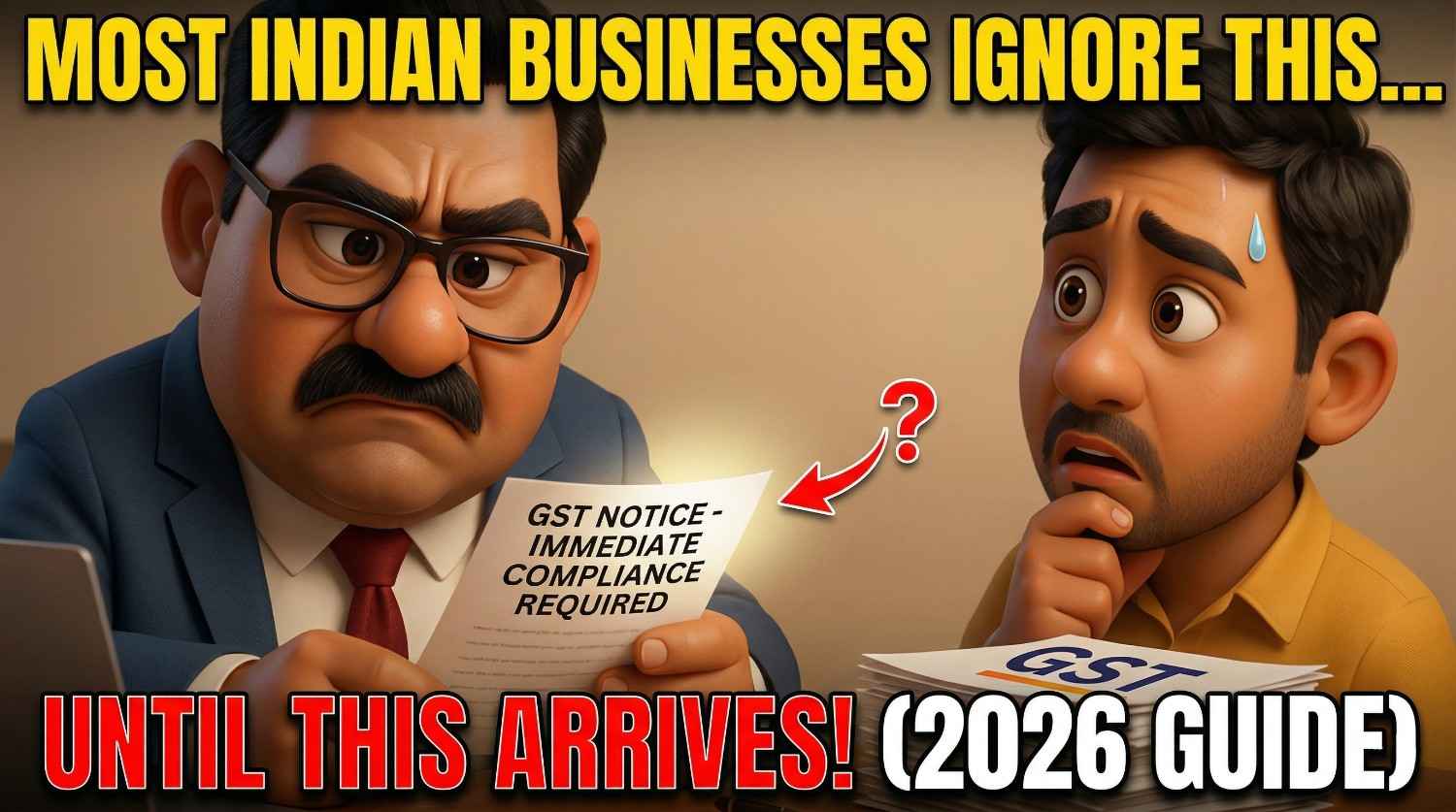
The Silent Trap Every Founder Faces
Picture your typical workday. You are negotiating deals, managing employees, solving customer complaints, and trying to keep your profit margins healthy. At the end of the month, your accountant hands you a summary sheet. You look at the final tax payable figure, authorize the payment, and go back to running your company. You feel safe because you paid what you were told to pay.
Unfortunately, paying your taxes on time is just a fraction of the battle. Beneath the surface, a mismatched invoice or an incorrect product code could be quietly triggering red flags in the government system. Most business owners in India view Goods and Services Tax compliance as just another monthly chore. They outsource it completely and assume that if no one is calling them, everything must be fine.
But things have changed drastically. The tax department in 2026 is not relying on manual audits anymore. They are using advanced artificial intelligence and massive data cross referencing to find errors instantly. By the time a physical notice arrives at your registered office, penalties and interest have already piled up to dangerous levels.
How the Government Algorithm Catches You
Before we talk about your mistakes, you need to understand how the system works. The modern tax portal connects your sales data with your income tax returns, your bank deposits, and your customs data. If you claim to have sold ten lakh rupees worth of goods, but your bank account shows fifty lakh rupees in deposits, the system generates an alert automatically.
It does not require a human officer to decide to audit you. The software issues notices automatically based on mismatches. This means you cannot hide in the crowd anymore. A single discrepancy between what you declare and what your suppliers declare will result in an automated demand letter. Let us dive into the five biggest mistakes that trigger these automated notices.
01. Blind Trust in Supplier Invoices
Imagine buying expensive raw materials from a regular vendor. You pay the invoice in full, naturally including the tax amount. You record it in your books and assume you can claim that tax back a process known as input tax credit. But what happens if your vendor forgets to upload your invoice to the government portal? Or what if they entered your official registration number slightly incorrectly?
The reality is harsh. If the invoice does not appear on the official government portal under your name, the government assumes it does not exist. If you claim credit against it anyway, the algorithm instantly flags you. Suddenly, you are paying tax twice. First to your careless supplier, and then to the government along with a hefty penalty.
Regularly matching your internal books with the official portal data line by line is absolutely essential now. Relying purely on mutual trust with your suppliers is a direct path to a financial penalty.
02. The Interstate Expansion Trap
Growth is exciting. As your business succeeds, you might start storing inventory in different states to speed up customer deliveries. Perhaps you joined a major ecommerce platform like Amazon or Flipkart and decided to use their regional fulfillment centers.
Countless founders have no idea that crossing state borders changes your legal obligations instantly. Keeping inventory in a different state usually means you are conducting business from that state. According to the law, this requires a fresh, separate registration in that specific jurisdiction.
If tax inspectors intercept your goods and find they originated from a warehouse not linked to your registration, they will seize the entire shipment. Getting those goods released involves fighting a massive bureaucratic battle while your customers wait angrily for their orders.
03. Throwing Away Legitimate Tax Credits
Input tax credit is essentially real cash sitting on the table. It ensures you are only taxed on the exact value you create, rather than absorbing tax costs on everything you buy. However, the exact rules defining what qualifies for a credit are incredibly detailed and often confusing.
For example, you bought laptops for your sales team. Did you claim the credit? You hosted a client at a restaurant. Can you claim that? You bought promotional gifts for a festival campaign. Are those eligible?
Many business owners swing between two dangerous extremes. Some blindly claim credits on everything including things explicitly blocked by law like motor vehicles and food services which triggers an immediate penalty notice. Others are so afraid of making a mistake that they skip claiming valid credits entirely. This silent mistake eats into your hard earned profit margins year after year without anyone noticing.
04. Casual Eway Bill Generation
When goods above a certain value leave your premises, you must generate an electronic waybill. Many transport managers treat this as a rough estimate. They enter an approximate distance or fail to update the document if the transport vehicle breaks down and ownership transfers to another truck halfway.
Tax checkpoints on highways are equipped with highly capable scanners that read vehicle number plates and instantly cross match them against the live digital database. If the vehicle number does not match exactly, or if the document has expired because the journey naturally took too long, the authorities will detain the shipment on the spot. The penalty for this is often equal to the full tax amount of the goods being transported. A simple typo by a tired logistics clerk can wipe out your profit for the entire month.
05. The Late Payment Interest Spiral
Cash flow is tight, and you are waiting on payments from big clients. The monthly deadline approaches, and you decide to delay paying the government for a few weeks until your collections come through. You assume you will just file late and pay the standard late fee.
This is a major miscalculation. Beyond the flat late fee, the government charges compound interest on the exact amount delayed, calculated daily. More dangerously, failing to file returns for consecutive months can result in your registration getting suspended or cancelled outright. Once your number is cancelled, your clients can no longer claim credit on the goods they buy from you. This single action can permanently destroy your relationships with major corporate buyers who demand perfect compliance from their vendors.
What to Do When the Notice Arrives
If you receive an email or a portal alert notifying you of a mismatch or a financial demand, your first instinct might be panic. Your second instinct might be to ignore it, hoping it gets lost in the system. Neither reaction will help.
The absolute worst thing you can do is respond emotionally or provide incomplete documentation without deeply understanding the exact section of the law cited in the notice. Notices run on strictly enforced deadlines. Missing the response window completely validates the demand amount, making it almost impossible to challenge later. You need professional intervention immediately to draft a legally sound response backed by solid accounting evidence.
How Tax Sahi Hai Protects Your Business
As a founder, your energy must be spent chasing revenue, building products, and leading your team. You should absolutely never be losing sleep over complex legal notices. That is precisely why we built Tax Sahi Hai.
Our service is not just about filing standard forms. Our advanced artificial intelligence technology scans your entire accounting ledger and matches every single invoice against the government portal automatically. We catch supplier errors before they ever become your problem. We ensure you claim every single rupee of valid credit while keeping you strictly within the legal boundaries.
Smart Compliance Engine
We handle your monthly returns with total precision. Our systems flag duplicate entries, incorrect tax rates, and unregistered vendors instantly, giving you complete peace of mind.
- * Guaranteed error free monthly filing
- * Continuous real time invoice reconciliation
- * Automated tracking of defaulting suppliers
- * Complete tracking of proper waybill creation
Notice Management Unit
Did an old tax notice suddenly arrive? Do not panic. Our seasoned chartered accountants and tax professionals know exactly how to decode departmental jargon and securely protect your assets.
- * Detailed review and rapid notice response
- * Direct communication with tax authorities
- * Professional representation during severe audits
- * Strategic planning for penalty reduction
Secure Your Business Operations Today
Do not wait until a catastrophic penalty forces your hand. Protect your profits proactively.