Why Most Expansion Plans Fail and How to Execute Yours Successfully
“A good expansion plan does not die from a bad idea. It dies from being executed at the speed of ambition instead of the speed of evidence.”
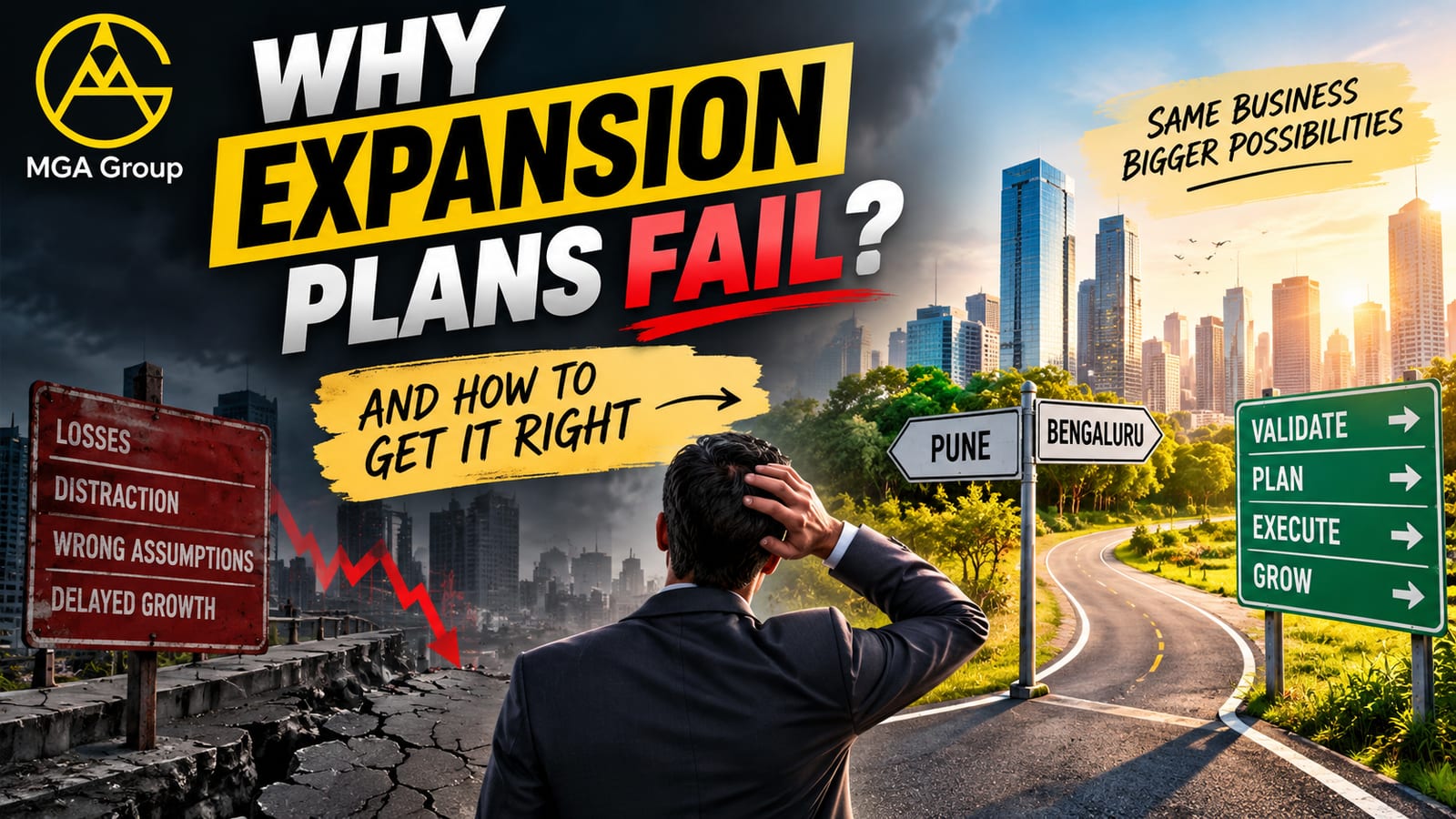
The Expansion That Looked Perfect on the Slide
A founder we advised ran a profitable home services business in Pune. Steady bookings, healthy margins, a small but loyal team. The expansion deck for Bengaluru looked airtight: bigger market, higher price points, a sector India's own data.gov.in continues to track as fast-growing, a competitor doing visibly well there. The plan projected breakeven in four months.
Eight months later, the Bengaluru branch was still losing money every single month, the Pune business had started slipping because the founder was splitting attention across two cities, a tradeoff we unpack in office setup, and the “four month breakeven” had quietly become a number nobody mentioned in team meetings anymore.
Nothing about the underlying business was broken. What broke was the assumption that a plan which worked once, in one city, under one set of conditions, would simply repeat itself somewhere else if executed with enough energy. Expansion does not fail because founders lack ambition. It fails because ambition gets treated as a strategy, the same root cause behind several business mistakes we see entrepreneurs repeat at every stage, not just at expansion.
This article is not a case against expanding. It is a map of exactly where these plans tend to break, and a sequence that keeps them from breaking in the same predictable places.
What made the Pune story particularly painful, looking back on it with the founder later, was how avoidable each individual decision had felt in isolation. Signing the Bengaluru lease before running a single test order felt efficient, not reckless, because waiting felt like leaving money on the table. Hiring three people upfront felt like being prepared, not premature, because a half-staffed launch felt embarrassing. Every choice made sense on its own. None of them made sense together, and nobody stepped back far enough to see the pattern until the losses had already compounded for months.
Why Expansion Plans Fail More Often Than They Succeed
Field observationAmong founders we have worked with, expansions that were sequenced deliberately, one location or one market segment at a time, reached sustainable breakeven at a noticeably higher rate than expansions launched all at once across multiple fronts.
The pattern is not about talent or capital. Well-funded, well-run businesses fail at expansion just as often as scrappy ones, sometimes more often, because capital lets them move fast enough to outrun their own evidence. A founder with less money is often forced to validate before committing. A founder with more money can afford to skip that step, right up until the moment the skipped step turns into a very expensive lesson.
We covered a closely related pattern in our piece on startup failures: the businesses that struggle are rarely the ones with a bad idea. They are the ones that scaled an assumption before testing it. Expansion is that same failure mode, arriving a few years later, dressed up as a strategic growth decision instead of a first-time mistake.
There is also a subtler reason expansions fail more often than founders expect going in: success in the original market creates a kind of false confidence that transfers where it should not. A founder who correctly read their home market once starts to trust that same instinct in a market they have never actually lived in or served. That instinct earned its credibility in a specific context, and credibility does not automatically travel with the founder to a new city, a new customer base, or a new competitive landscape.
The Five Failure Patterns Behind Every Failed Expansion
Almost every failed expansion we have seen traces back to one or more of the same five patterns, regardless of industry. It is worth noting that this overconfidence is not unique to expansion decisions either. We saw a similar dynamic play out in our piece on investment mistakes, where the same instinct that builds a good business quietly makes its owner a worse decision-maker outside the domain that instinct was actually trained in.
Unvalidated Demand
Assuming the new market wants the same thing, at the same price, for the same reasons as the original market, without ever testing that assumption on a small scale first.
Copy-Paste Playbook
Replicating pricing, messaging, and operations exactly as they worked at home, without adjusting for local competition, buying behaviour, or cost structure.
Regulatory Blind Spots
Underestimating how much state-level registration, tax, and licensing requirements differ from what the business already handles at home.
Cash Flow Overreach
Funding the new location with a runway sized for the optimistic projection instead of the realistic one, leaving no room for a slower ramp than expected.
Divided Founder Attention
Treating a new location as something that can run on autopilot from day one, when in reality it needs as much hands-on founder attention in its first year as the original business did.
What Separates Expansions That Actually Work
Expansions that succeed are rarely the boldest ones. They are usually the most sequenced ones, built around two disciplines that sound almost boring next to the excitement of entering a new market, the same phased discipline behind our ₹10 crore roadmap, where each year builds deliberately on proof from the year before it rather than skipping ahead on optimism.
Sequencing Over Speed
A sequenced expansion tests one variable at a time: first whether demand exists at all, then whether it exists at a viable price, then whether it can be served profitably at scale. A rushed expansion tests all three simultaneously, which means when something goes wrong, nobody can tell which of the three assumptions actually broke.
Local Validation Over Assumption
This does not require a formal market research budget. It can be as simple as running a limited pilot, a pre-launch waitlist, or a small batch of paid orders in the new city before committing to a lease, a team, or inventory. The businesses that skip this step are not being efficient. They are simply moving the cost of learning from a small, cheap experiment to a large, expensive failure.
There is a third discipline worth naming separately, because it rarely gets discussed alongside sequencing and validation: the willingness to walk away from a location that is not working, even after real money and real time have already gone into it. This is genuinely difficult, because the instinct to justify a sunk cost is strong, and admitting a location is not going to work feels like a personal failure rather than a normal outcome of taking a calculated risk. Founders who expand successfully over multiple locations tend to be the ones who treat an underperforming location as data, not as a verdict on themselves.
The Execution Roadmap
Once the decision to expand is real, the sequence below is what separates expansions that stabilise from ones that quietly bleed the parent business.
Validate Before You Commit Capital
Run a small, low-cost test in the new market before signing a lease or hiring a team. A waitlist, a pilot batch, or a short paid pop-up will tell you more than any projection.
Register and Structure the Entity Correctly
Confirm whether the new location needs a fresh GST registration, a branch structure, or a separate entity, before revenue starts flowing through it.
Build a Local, Not Copied, Marketing Plan
Adjust messaging, pricing, and channels to how the new market actually behaves, rather than repeating what worked at home word for word.
Fund It for a Slower Ramp Than You Expect
Size the runway for the pessimistic case, not the projection you pitched internally. Slower ramps are the norm, not the exception.
Hire in Step With Proven Demand
Bring on the minimum team needed to serve validated demand, then scale headcount as revenue actually justifies it, not ahead of it.
Review Monthly Against the Original Plan
Compare actual performance to the original assumptions every month, and set a clear checkpoint where you decide to continue, pause, or pull back.
Reckless vs Sequenced Expansion
| Area | Reckless Expansion | Sequenced Expansion |
|---|---|---|
| Demand | Assumed from HQ success | Tested with a small pilot first |
| Cash flow | Runway sized to the best case | Runway sized to the slow case |
| Hiring | Full team hired upfront | Team scaled with proven demand |
| Compliance | Handled after launch, reactively | Confirmed before revenue starts |
| Founder attention | Split evenly, immediately | Concentrated until location stabilises |
Financing Expansion Without Breaking Cash Flow
The single most common reason a stable, profitable business turns wobbly during expansion is not a bad market. It is cash flow mismatch: money going out for the new location every month while revenue takes longer than expected to catch up, and the original business quietly subsidising a bet that has not proven itself yet.
Eligible small businesses exploring formal credit or scheme-based support for expansion can review current options directly on msme.gov.in, rather than relying on secondhand summaries of what is currently available.
For businesses considering formal lending as part of expansion financing, it is also worth understanding the regulatory backdrop shaping interest rates and lending norms, which the rbi.org.in website publishes directly. This matters less as bedtime reading and more as a sanity check before signing a loan agreement someone else has already decided is a good idea for you.
We explored a related discipline in our piece on income diversification, and the same logic applies here: expansion capital should ideally come from a plan, not from draining whatever the core business happens to have on hand that month.
The Compliance Reality of a New State
GST in India is structured so that operating in a new state typically requires its own state-specific registration, not a simple extension of an existing one. Founders who assume their current GST registration automatically covers a new location often discover the gap only after invoices are already going out incorrectly. The authoritative rules and registration process are published directly on gst.gov.in, and it is worth confirming requirements there before assuming your existing setup transfers cleanly.
There is also a separate, and frequently confused, piece of the compliance picture: DPIIT recognition under the central government's own Startup India initiative. This is a government scheme, run by the Department for Promotion of Industry and Internal Trade, with its own eligibility rules and application process detailed on startupindia.gov.in. It is a distinct entity from any privately branded incorporation or advisory service that happens to share a similar name, and founders should always confirm which one they are actually engaging with before assuming government-backed status.
How MGA Group Can Help
Expansion touches almost every function of a business at once. Here is where MGA Group's network of companies fits into that sequence.
| What You Need | How We Help | Link |
|---|---|---|
| GST registration and tax compliance for a new state | Structured tax advisory and filing support built for multi-location compliance | Tax Sahi Hai |
| Local demand generation and market entry marketing | Region-adjusted campaigns, SEO, and brand positioning for the new market | MGA Brand Buzz |
| Office or coworking space in the new city | Flexible workspace without a long lease commitment while demand is validated | MGA Properties |
| Procurement and cost efficiency at a larger scale | Collective buying leverage on materials and supplies as operations grow | Smart Buying |
| Capital planning for expansion without straining personal wealth | Structured financial planning that separates business risk from personal security | Wealth and Beyond |
| Registering a new branch entity correctly from day one | Incorporation and structuring support, distinct from the government's own Startup India scheme | Startup India Initiative |
Mid-Expansion Mistakes Founders Make
Tip
Set your pause-or-continue checkpoint before launch, not after. Deciding the criteria while emotionally invested in a struggling location almost always leads to giving it “one more month” indefinitely.
Note
A slower ramp than projected is not automatically a failing signal. The real signal is whether the trend line is improving month over month, even slowly, or genuinely flat.
Beyond the five core failure patterns already covered, three smaller habits tend to compound the damage once an expansion is already underway. Founders keep funding a location past its honest checkpoint because shutting it down feels like admitting defeat. Reporting for the new location stays separate from core business reporting long enough that nobody notices the core business is now subsidising it. And local hires are given responsibility without the context the founder has, then blamed when decisions do not match what the founder would have chosen.
None of these are dramatic on their own. Together, over two or three quarters, they are exactly how a promising expansion quietly becomes a drag on a business that was healthy before it started.
Frequently Asked Questions
Why do most business expansion plans fail?
Most expansion plans fail because they scale a growth plan on a slide deck rather than in the market: unvalidated demand in the new location, blindly replicating the HQ playbook, underestimating state-level compliance differences, and overextending cash flow before the new location is self-sustaining.
How do I execute a business expansion plan successfully?
Sequence it rather than sprint it: validate demand in the new market before committing capital, register and structure the new entity or branch correctly, build local marketing and hiring plans before opening, keep a cash runway that assumes a slower ramp than projected, and review actual performance monthly against the original plan rather than assumptions.
What are common mistakes when expanding a business in India?
Assuming demand without local validation, copying pricing and positioning from the home market without adjustment, missing state-specific GST registration requirements, hiring a full team before revenue justifies it, and underestimating how much founder attention a new location needs in its first year.
How can I scale a business without losing control of it?
By expanding one location or market at a time rather than several simultaneously, keeping financial reporting centralised even as operations decentralise, documenting processes before replicating them elsewhere, and setting clear checkpoints where you decide to continue, pause, or pull back based on real data.
What should a business expansion checklist include?
Validated local demand, correct legal and GST registration for the new state, a realistic cash flow runway of at least twelve months, a local marketing and hiring plan, defined success metrics with review checkpoints, and a documented version of whatever made the original business work.
How much cash flow runway do I need before expanding?
Most sequenced expansions need at least twelve months of runway for the new location alone, independent of the core business, since new markets almost always take longer to break even than the original projection assumed.
Is DPIIT recognition required to expand a business in India?
DPIIT recognition under the government's Startup India initiative is not mandatory for expansion, but it can unlock tax and compliance benefits for eligible entities, and details are available directly on startupindia.gov.in.
Final Thoughts
Expansion is not a reward you unlock for running a good business. It is a second business, built on top of the first one, with its own risks, its own learning curve, and its own capacity to quietly damage what already worked if it is rushed.
None of the founders whose expansions failed lacked drive. What they lacked was a sequence that let evidence catch up with ambition before the money ran out. That sequence is not complicated. It just has to actually be followed.
Plan Your Expansion Properly
From compliance and tax structuring to marketing and workspace, MGA Group's network of companies can support every stage of a sequenced expansion.
Get In Touch